
1. Eat pintxos in San Sebastian


Visiting San Sebastian (Donostia) and not eating pintxos could practically be considered a sin. I’m not kidding! If you come to the city, stopping by some of the best pintxo bars is a must. You have to try the incredible local food San Sebastian is famous for!
Some of the most popular places to eat pintxos in San Sebastian include La Cuchara de San Telmo, Bar Sport, Borda Berri, La Viña, Atari, Goiz Argi, Txepetxa, Dakara Bi, Txuleta, Gandarias… and many more!
🛏️ RECOMMENDED HOTELS IN SAN SEBASTIAN The times I’ve stayed in the city, I’ve chosen different types of accommodations, and depending on your budget or preferences, I recommend one or the other. The first hotel is this one located in the Old Town, next to the port. It’s beautiful. The other hotel is this accommodation in Antiguo, on the outskirts of the city.
2. Basílica de Santa María del Coro
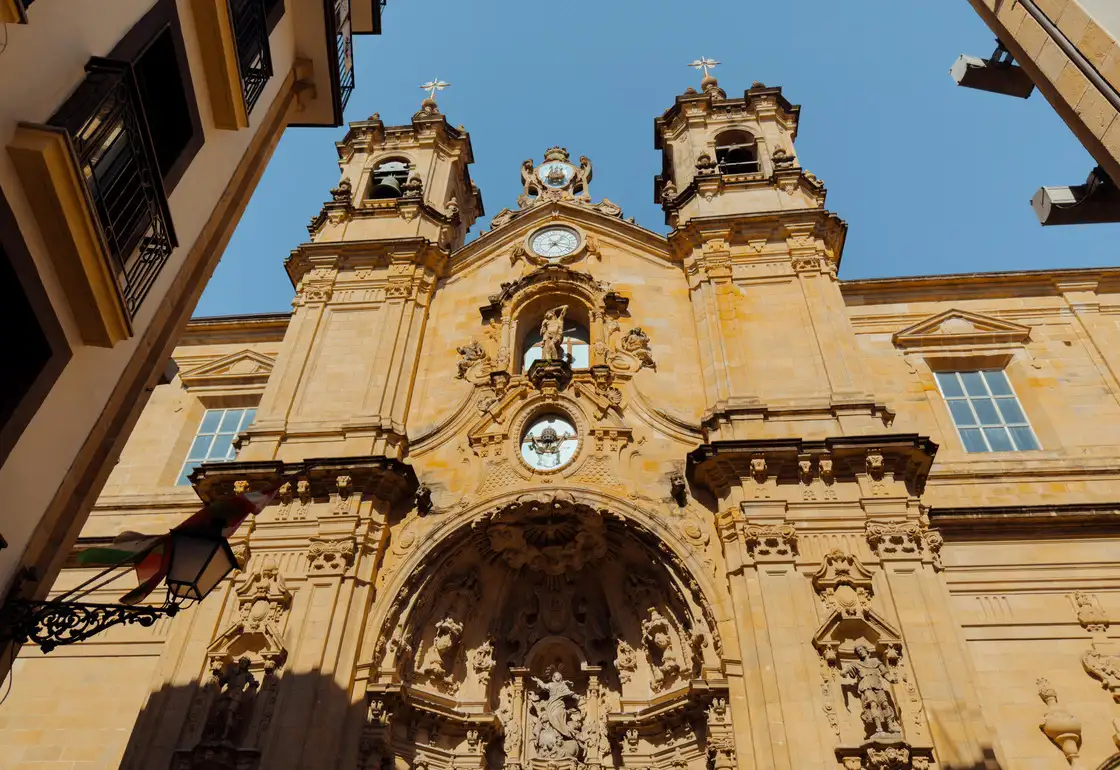
As you walk along Calle Mayor in San Sebastian’s Old Town, you’ll see the Basilica of Santa María del Coro at the far end, right next to Mount Urgull. It was built in the mid-18th century and is mainly Baroque, though it also includes Gothic, Neoclassical, and Churrigueresque elements.
The building was constructed on top of an old Romanesque church, which is why the Basilica of Santa María del Coro is considered the oldest temple in the city. Its beautiful portico is especially striking.
3. San Sebastian Port and the Paseo Nuevo

One of the most charming corners of the city is the picturesque Port of Donostia, right next to the Old Town. It has a really special atmosphere and is perfect for a stroll while you enjoy the beautiful views of the city.
From the port, you can follow the Paseo del Muelle, which then becomes the Paseo Nuevo as it curves around Mount Urgull. It’s a completely flat and very pleasant walk, with the sea right beside you. Don’t miss Construcción Vacía by Jorge Oteiza, an eye-catching sculpture along the way.
4. Mount Urgull

San Sebastian has three hills: Mount Igueldo, Mount Urgull, and Mount Ulia.
Mount Urgull sits right behind the Old Town. I recommend walking up and exploring the different points of interest along the way. There are several access points, but the entrance next to the San Telmo Museum is the best place to start.
Your first stop will be the Baluarte del Mirador, which offers lovely views over the Gros district and Zurriola Beach. This was the main gateway to the military grounds on Mount Urgull and its most important defensive point.
Continue walking and you’ll reach the English Cemetery. Most of the remains here belong to officers of the British Auxiliary Legion who died near Donostia during the First Carlist War.
Your next stop will be the Castillo de la Mota, the main highlight of Mount Urgull. Its origins date back to the 12th century, when the Kingdom of Navarre built a square-shaped tower here. At the very top stands the statue of the Sacred Heart of Jesus, added in 1950.
At the foot of the castle, you’ll find Napoleon’s Battery, built by the French during the imperial occupation (1808–1813). It’s the most recent battery on Mount Urgull.

To finish your visit to the hill, I recommend heading to the terrace at Polboriña Bar, located at the top of Mount Urgull, where you can enjoy a beautiful sunset.
5. San Telmo Museum

If you enjoy museums, a great plan in San Sebastian is visiting the San Telmo Museum. It’s located in a former 16th-century Dominican convent in the Old Town, right next to Mount Urgull.
Opened in 1902, it is the oldest museum in the Basque Country. The main focus of the San Telmo Museum is Basque society and its historical and cultural heritage. It features several areas, including ethnography, fine arts, history, archaeology, and photography.
The museum is open from Tuesday to Sunday, 10:00 a.m. to 7:00 p.m. (10:00 a.m. to 8:00 p.m. from April to October). It also opens on public holidays and long weekends. It is closed on January 1st and 20th, and December 25th.
General admission is €10. If you are a student, over 65, or part of a large family, tickets cost €4. Entry is free for anyone under 25. On Tuesdays, admission is free for all visitors.
6. Church of San Vicente

Another must-see in San Sebastián is the Church of San Vicente, located in the Old Town.
This late Gothic church with a rectangular floor plan began construction in 1507 and is considered the oldest monument in Donostia. It was designed by Miguel de Santa Celay and Juan de Urrutia. Highlights include the main altarpiece of San Vicente and the Altarpiece of the Souls.
7. Plaza de la Constitución

One of the most beautiful places in San Sebastian, and one of my favorites, is the Plaza de la Constitución, located in the Old Town. Besides its stunning beauty, it’s also the venue for many of the city’s celebrations.
One detail that really catches the eye is the numbers above each window. They correspond to the boxes of the bullring that once stood here. You’ll also find plenty of terraces where you can sit and enjoy a drink.
🎟️ A great way to explore the Old Town is by joining this free city tour. It lasts between 2 and 2 and a half hours, and you’ll visit some of the main spots in the city. Check out the best free tours in San Sebastian.
8. Plaza Gipuzkoa

Another square you can’t miss in Donostia is Plaza Gipuzkoa, the city’s first public park. This green space is right in the heart of San Sebastian, just opposite the Gipuzkoa Provincial Council, and was designed by the French gardener Pierre Ducasse.
The square stands out for its abundance of flowers, plants, and trees, as well as a pond with swans and ducks, a flower clock, a meteorological gazebo, a marble time table, and the monument to the local musician José María Usandizaga.
9. Cathedral of the Good Shepherd

The Cathedral of the Good Shepherd, in Neo-Gothic style, is located in the center of San Sebastian. Opened in 1897, it is the largest religious building in the city and was designed by the Basque architect Manuel Echave. Its tower reaches 75 meters high and can be seen from much of the city.
An interesting fact: it is exactly one kilometer from the Basilica of Santa María del Coro, with no buildings in between. While in the city center, don’t miss strolling along Calle Urbieta, Calle Hondarribia, and Calle Getaria.
10. Playa de la Concha

La Concha Beach is one of the city’s iconic spots and an absolute must when visiting San Sebastian. If the weather is good, make sure to grab a spot along its 1,350 meters of sand and enjoy a refreshing swim. It’s considered one of the best urban beaches in the world!
If the weather isn’t good enough for swimming, I recommend taking a pleasant walk from the port all the way to Pico del Loro. Along the beach, you’ll also find La Perla, a wellness center with a spa, gym, and restaurant.
11. Donostia City Hall

One of the buildings you can’t miss in San Sebastian is the one housing the City Hall. It was built in 1887 and originally served as a casino.
In 1924, gambling was banned and the building closed. A few years later, it was used by the Centro de Atracción y Turismo, and finally, in 1945, the Donostia City Hall moved in. Before that, it had been located in the Plaza de la Constitución.
In front of the building is Parque Alderdi Eder, a charming park with beautiful gardens perfect for strolling and relaxing. Highlights include the sculpture of Don Quixote and Sancho Panza, a carousel, and the sculpture known as “Grupo de Leones”.
Next to the City Hall is the Alameda del Boulevard, which connects the Old Town with the newer part of the city.
12. Zurriola Beach, one of the best beaches in San Sebastian

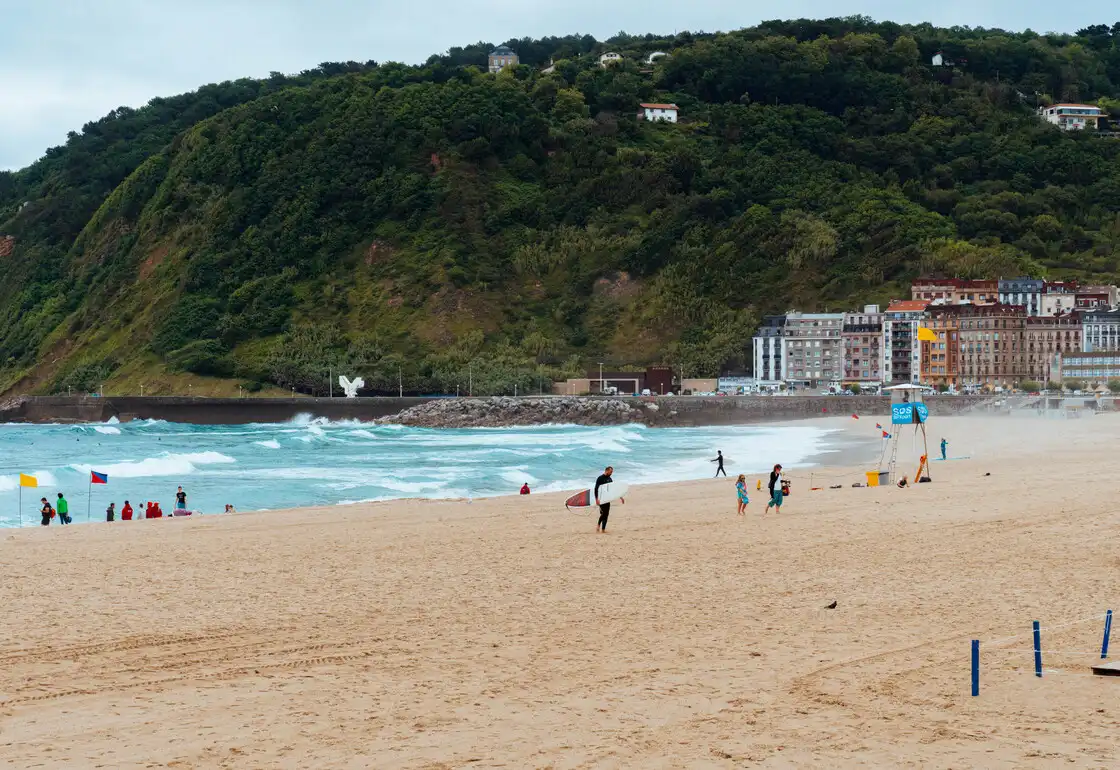
Zurriola Beach is located in Gros, the most modern neighborhood in San Sebastian. It’s the most popular beach for surfers, so if you want to catch some waves or take your first surf lesson, this is the place to be. It’s also a great beach for swimming and sunbathing.
I recommend taking a walk all the way to the “Paloma de la Paz” statue at the eastern end of the beach. From here, you can watch the surfers up close and enjoy a beautiful sunset.
13. Miramar Palacer

Another place to visit in San Sebastian is the Miramar Palace, built in English style. It’s located between La Concha Beach and Ondarreta Beach.
The Spanish Royal Family first arrived in San Sebastian in August 1887, breaking with the Bourbon tradition of spending summers in La Granja or Aranjuez.
Queen María Cristina loved her time in the city, and in 1893 she decided to buy the land of El Antiguo to build her country house, Miramar, where she spent her summers for 40 years. After her death, the property passed to Alfonso XIII. During the Second Republic, it was expropriated, and later returned to the Bourbons.
In 1972, the City Council purchased the palace and its gardens. Today, you can visit the landscaped areas, which are definitely worth seeing. They are beautiful and offer stunning views.
14. Mount Ulia

As I mentioned, San Sebastián has three hills: Mount Igueldo, Mount Urgull, and Mount Ulia.
The last one, Mount Ulia, is located in the easternmost part of the city, next to the Gros neighborhood. You can climb it and stay close to the city just to enjoy the views, or take a walking route all the way to Pasajes. I chose the second option.
The hill has several trails, some inland and others closer to the coast. To start the climb, head to the Larramedi service station and go to the back, where you’ll find the beginning of a trail. The hike to Pasajes takes around 2 hours, depending on the route you take and whether you make any stops.
Once you reach Pasajes, I recommend taking the San Pedro to San Juan boat and grabbing a drink there. I returned from Pasajes to San Sebastian by bus.
15. Mount Igueldo


One of the most beautiful views of San Sebastian can be enjoyed from the Mount Igueldo lookout.
You can get there on foot (about a 30-minute walk), by car, or by funicular. A round-trip ticket on the funicular costs €4.75, or €3.30 for a one-way ticket. If you go on foot or by car, the fee is €2.50 per person. The funicular usually opens at 11:00 a.m., though on some days it opens at 10:30 a.m.
I went up and down by funicular, but I recommend walking down, as the views are stunning. This way, you can pass by the Mount Igueldo Lighthouse.
Next to the lookout, you’ll find an old amusement park, a café, a turret, a hotel, and several food stalls. You can find more information about this spot on the official Mount Igueldo website.
16. Peine del Viento, Eduardo Chillida’s sculpture

If you continue along the coast past Ondarreta Beach, you’ll reach the westernmost point of the promenade, where the Peine del Viento is located, one of the most iconic sculptures by Eduardo Chillida, the Donostia-born artist.
I found it to be a place with a very special atmosphere, perfect for sitting for a few minutes and taking in the power and energy of the sea.
17. Kursaal Center

The Kursaal Congress Centre and Auditorium is located in the Gros neighborhood, next to Zurriola Beach. The building consists of two large glass cubes, one bigger than the other. It houses a main auditorium, exhibition halls, a large chamber hall, and several multipurpose rooms.
It hosts a wide variety of events, the most notable being the San Sebastian International Film Festival. You can find more information about events and tickets on the official Kursaal website.
18. Santa Clara Island

Santa Clara Island is located in La Concha Bay. You can take a small boat from the San Sebastian port to visit this tiny island. When the tide is low, there’s a small beach where you can take a swim. The island also has a beach bar, a lighthouse, and several picnic areas.
You can book your boat trip to Santa Clara Island in advance. A round-trip ticket costs €8. You choose your departure time and can return whenever you like.
19. Ondarreta Beach

If one of the reasons you’re visiting San Sebastian is to enjoy its beaches, another spot worth checking out is Ondarreta Beach, located at the western end of the city. It stretches for 600 meters and is a great option if you want to try water sports.
Behind the beach, there’s a lovely park perfect for a stroll, featuring a statue of Queen María Cristina. Just beyond the park is the residential neighborhood of Antiguo.
20. La Tabakalera
A different thing to do in San Sebastian, especially if you love culture, is to visit Tabakalera, an international center for contemporary culture. Its name comes from the fact that the building housed a tobacco factory for 90 years.
In 2015, it reopened with the goal of “contributing to the development of the creative and critical capacity of Basque society, promoting creative and participatory leisure”. It focuses mainly on cinema and audiovisual arts, contemporary art, and cultural and creative industries
If you’re interested in visiting, you can check the official Tabakalera website for the program and events.
21. Zurriola Bridge and María Cristina Bridge

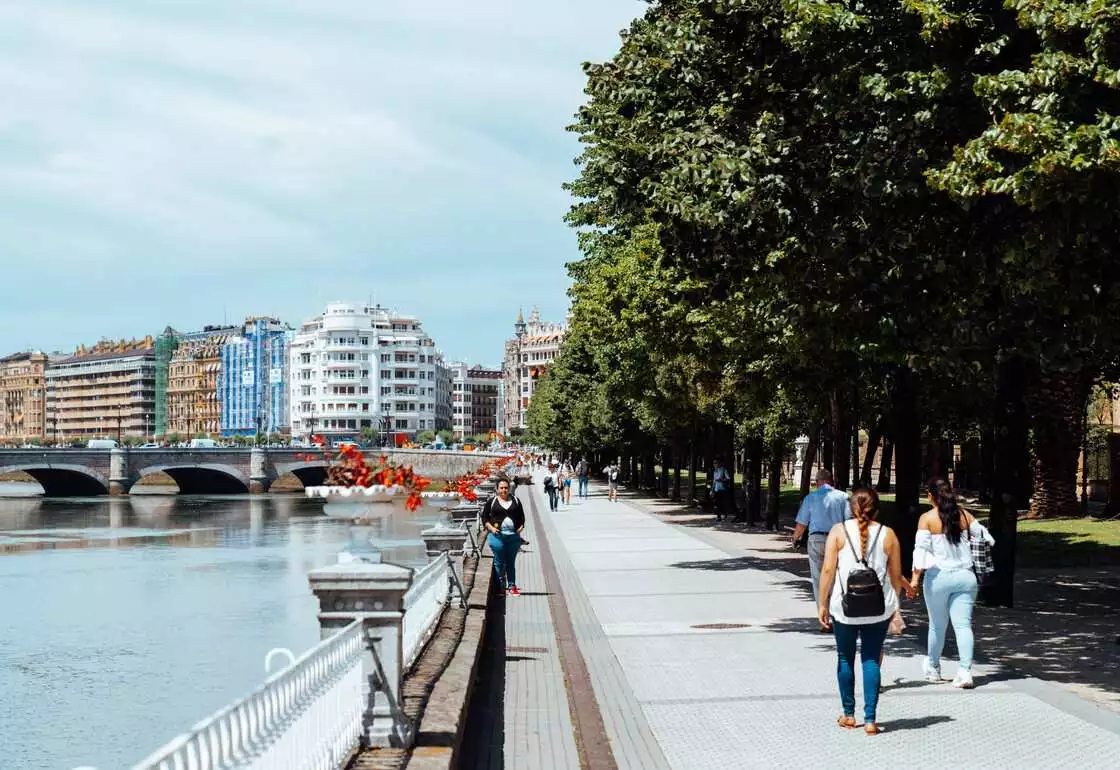
There are several bridges that cross the Urumea River in San Sebastian, but the María Cristina Bridge and the Zurriola Bridge are the most notable.
The Zurriola Bridge is the one closest to the coast, connecting the city center with the Gros neighborhood. It was built in 1915 and is especially notable for its white and green street lamps.

The María Cristina Bridge is also one of the most beautiful and elegant bridges in the city. It was built in 1904 and designed by José Eugenio Ribera and Julio María Zapata. The two obelisks at each end of the bridge are particularly striking.
22. Victoria Eugenia Theatre and María Cristina Hotel

Another must-see building in Donostia for its architecture and cultural significance is the Victoria Eugenia Theatre. It was inaugurated in 1912 and has hosted events such as the San Sebastian International Film Festival and the Quincena Musical.
Next to this elegant theatre is the María Cristina Hotel, one of the city’s most iconic hotels. It was designed by the French architect Charles Mewes, who also designed the Ritz hotels in Madrid and Paris. Its interior takes you back to the elegance of the Belle Époque.
23. La Bretxa Market

Next, we have the La Bretxa Market, located in the Old Town. The building is neoclassical in style and was constructed in 1870.
Years later, the building that houses the fish market was built behind it, leaving a plaza between the two where local vendors set up their stalls. At this market, you can find a wide variety of local products.
24. Cristina Enea Park
If you feel like surrounding yourself with greenery and taking a relaxing stroll, one of the best things to do in San Sebastian is to visit Cristina Enea Park, located in the Egia neighborhood, next to Gros.
Its history dates back to the second half of the 19th century, when the Duke of Mandas purchased the land with the intention of building a mansion with gardens. The park is named in honor of his wife, Cristina Brunetti. When the dukes passed away, the property was donated to the city.
In 2008, the Cristina Enea Foundation was established, aiming to promote a more environmentally responsible approach to urban development.
25. Ayete Palace
Next, we head to the Ayete Palace, commissioned by the Dukes of Bailén in 1878 and designed by the French architect Adolfo Ombrecht. It features 74,000 m² of gardens designed by Pierre Ducasse.
Before the Miramar Palace was built, this was the residence of the Spanish monarchs Isabel II, Alfonso XII, María Cristina, and Alfonso XIII when they visited the city. Today, it houses the House of Peace and Human Rights.
What to see around San Sebastian

A great idea if you’re spending several days in the city is to take a trip to explore the surroundings of San Sebastian.
To the west, you’ll find towns like Zarautz, Getaria, and Zumaia, while to the east, there’s Pasajes and the beautiful town of Hondarribia. If you cross the border, you can visit Hendaye, Saint-Jean-de-Luz, or Biarritz, all part of the French Basque Country.
Biarritz is a coastal town with a strong surf vibe and charming corners to explore. It also has plenty of great places to eat. By car, it’s about a 50-minute drive, or you can get there by bus. If you prefer, you can check out this organized tour to Biarritz and the French coast.
Another fantastic option is Hondarribia, a colorful and charming village. Some of its most beautiful spots are Calle Mayor, Plaza de Armas, and Plaza de Gipuzkoa. It’s about a 30-minute drive from Donostia. If you prefer, you can book this organized tour to Hondarribia.
If you’re more into nature, don’t miss the incredible Zumaia Flysch, a truly spectacular site! It’s about 40 minutes by car from San Sebastian. On the way, be sure to stop by Getaria and Zarautz.
If you’d rather stay closer to the city and enjoy a cultural visit, you can go to the Eureka! Science Museum, a space dedicated to scientific education for both adults and children, or the Chillida Leku Museum, a landscaped park filled with sculptures by Eduardo Chillida Juantegui.
For more information on all the trips you can take from the capital of Gipuzkoa, check out my article on the best day trips from San Sebastian.
Where to stay in San Sebastian

Generally, the best areas to base yourself in the city are the Old Town, the City Center, and Gros. However, there are many other neighborhoods that can also be great options. In this guide on where to stay in San Sebastian, I cover all the areas of the city I recommend for accommodation.
Now, let me tell you about the hotels I’ve personally stayed in.
The first time I stayed in the city, I chose Hotel Sansebay, and I loved it. It’s located in the Old Town, right next to the port. The location is perfect, as you can walk to almost anywhere in the city. My room was spacious, bright, very clean, and had beautiful views of La Concha Bay.
I found the breakfast at the hotel café really good. They had a wide variety of products, and everything I tried was delicious. The hotel staff were lovely. Another thing I really appreciated was that the bathroom offered high-quality gel, shampoo, and conditioner; something that makes a big difference!
For my second visit, I was looking for accommodation that offered good value for money and easy parking, since we planned to visit some places in the surroundings of San Sebastian. We ended up at Olarain, a hotel that also serves as a student residence, located in the Antiguo neighborhood. We had a comfortable stay.
Map of best things to do in San Sebastian
On this map, you can see all the places to visit in San Sebastian that I’ve mentioned, along with some of the best pintxo bars and the hotels I’ve stayed in.
I hope this article on things to do in San Sebastian has been really helpful for planning your visit to this wonderful city.
If you’re planning a longer trip through the Basque Country, take a look at my selection of the best places to visit in the Basque Country.
If you have any questions about traveling in the Basque Country, feel free to leave a comment or send me an email. See you next time!